
7 September 2026 | Patient Preparedness | MyCareQuestions
Why understanding how age influences treatment options can help you have a better conversation with your doctor.
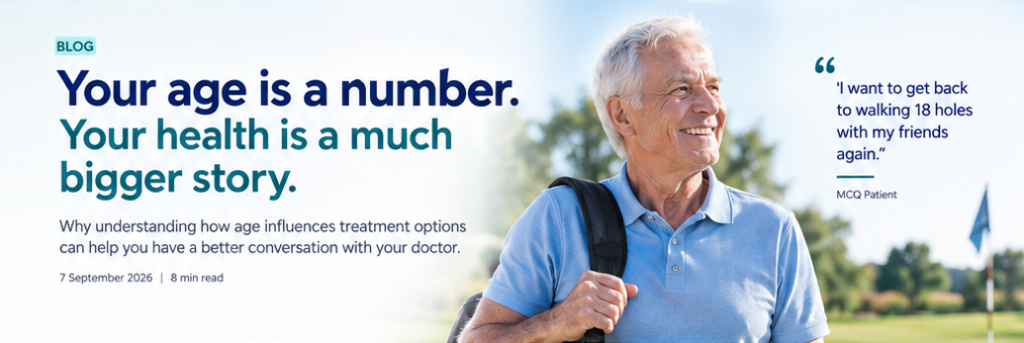
Two people can both be 70 years old. One may cycle to their hospital appointment, play golf twice a week and be planning their next walking holiday. Another may have several serious medical conditions, struggle with everyday activities and need considerable help getting around.
“On paper, they share the same age. Medically, they may be very different people.”
Age plays an important role in healthcare. It can help clinicians estimate risk, likely longevity, treatment durability and the strength of evidence for different options. The problem comes when chronological age starts to tell too much of the story.
At MyCareQuestions, we believe the right questions can help your clinician see the person, not just the number.
The 70-year-old golfer
Imagine someone who has recently turned 70. They still play golf regularly. They walk the course rather than using a buggy. They travel, garden, look after grandchildren and expect to remain active for many years.
Their objective from treatment may not simply be to live longer. It may be to keep golfing, keep walking, keep travelling and keep living independently.
That information does not mean they should automatically receive a particular treatment. Nor does being exceptionally fit remove the risks associated with getting older. But it is an important part of the person sitting in front of the clinician.
A birth date tells us how long someone has lived. It does not completely tell us how they live.
Age and treatment: the bigger picture
Clinical guidelines sometimes use age thresholds because age can provide useful information about risk, life expectancy, how long a treatment needs to last and the evidence available. But chronological age is only one part of the picture. Lifestyle, other health conditions, fitness, frailty, goals and personal preferences can also matter.
| “Some 70 year olds cycle to my clinics and are worried about their next walking holiday or cycling trip with friends, while others are wheeled in because they are far more inactive.” Consultant surgeon |
Heart valve treatment: more than just a number
Heart valve disease is one of the clearest examples of age influencing treatment options. European guidance uses age as one factor when considering surgical aortic valve replacement versus transcatheter aortic valve implantation (TAVI), and age also features in discussions about mechanical versus biological replacement valves.
But treatment is not decided by age alone. The clinical team may also consider overall health, other medical conditions, anatomy, procedural risk, how long a treatment is likely to last, future treatment possibilities, lifestyle and patient preferences.
A useful question: “How much is my age influencing this recommendation, and what other things about my health, lifestyle and priorities have you considered?”
Hip and knee replacement: activity matters
For osteoarthritis, NICE is clear that people should not be excluded from referral for joint replacement because of age. Referral should be based on clinical assessment, symptoms, function and the effect on quality of life.
For one 72-year-old, a painful knee might be an inconvenience. For another, it could mean giving up golf, abandoning walking holidays, becoming progressively less active and losing an important part of their social life.
“I want to get back to walking 18 holes with my friends again.”
This matters, it matters a great deal.
Cancer treatment: individual circumstances count
In cancers such as localised prostate cancer, treatment choices can depend on the characteristics of the cancer, other health conditions, likely life expectancy and the patient’s own preferences. Chronological age and remaining healthy life are related, but they are not identical.
A highly active older person with relatively few other health problems may therefore have different priorities from someone of exactly the same age who is frail and living with several serious illnesses.
Fertility treatment: when age really matters
There is an important reason not to turn ‘age is just a number’ into an absolute rule. In some areas, age is a strong biological predictor. Fertility treatment demonstrates this clearly. NICE guidance contains specific age-related IVF recommendations because the chance of successful pregnancy changes with age.
MCQ is not about arguing against clinical guidelines. It is about helping patients understand when age matters, why it matters and what other individual factors should sit alongside it.
It’s not just age – there are other thresholds too
Healthcare necessarily uses thresholds. Depending on the condition, decisions may be influenced by BMI, risk scores, disease severity, frailty, kidney function, heart function, life expectancy or other clinical measurements.
Guidelines are designed for groups of patients. They cannot describe everything that matters about you. The important question is whether a threshold is an absolute requirement, a guideline recommendation, a local policy or one part of a broader clinical judgement.
Your lifestyle is clinical information
Patients sometimes underestimate the importance of telling clinicians about ordinary life: golf, cycling, walking the dog, gardening, work, travelling, looking after grandchildren or caring for a partner.
These details help explain what good health actually means to that particular person.
“I don’t want to be breathless” is important. “I want to be able to walk 18 holes with my friends again” gives that objective a much richer human context.
Complete our complementary questionnaire to help prepare for your next medical consultation. Designed by our NHS Consultant Clinicians to help you get the key information across.
6 example questions to take to your next appointment
- How much is my age influencing the treatment you are recommending?
- Is that an absolute clinical requirement, a guideline recommendation, a local policy, or one factor in your judgement?
- What other aspects of my health, fitness or frailty influence the decision?
- Does my normal level of activity – including golf, exercise, hobbies, work or caring responsibilities – change the balance between my options?
- What are the reasonable alternatives, and what are the advantages and disadvantages for someone like me?
- If a treatment is not available or recommended here, would it be reasonable to discuss my case with another specialist or specialist centre?
A better conversation. A more informed you.
Age can be important. But it does not define you. The right questions can help make sure your treatment options take account of the whole person – not just the number.
Be prepared. Ask the right questions. Live the life you want.
| Your life matters. Your questions matter. MyCareQuestions helps patients prepare for better conversations about their care. |
Clinical sources
- NICE NG208 – Heart valve disease presenting in adults: investigation and management
- 2025 ESC/EACTS Guidelines for the management of valvular heart disease
- NICE NG226 – Osteoarthritis in over 16s: diagnosis and management
- NICE NG131 – Prostate cancer: diagnosis and management
- NICE fertility guidance and IVF quality standards
- NICE NG246 – Overweight and obesity management
Important: This article provides general patient education and is not medical advice. Treatment decisions should be made with an appropriately qualified healthcare professional, taking account of individual circumstances.