A MyCareQuestions white paper for patients, clinicians, healthcare organisations and the media/ BBC
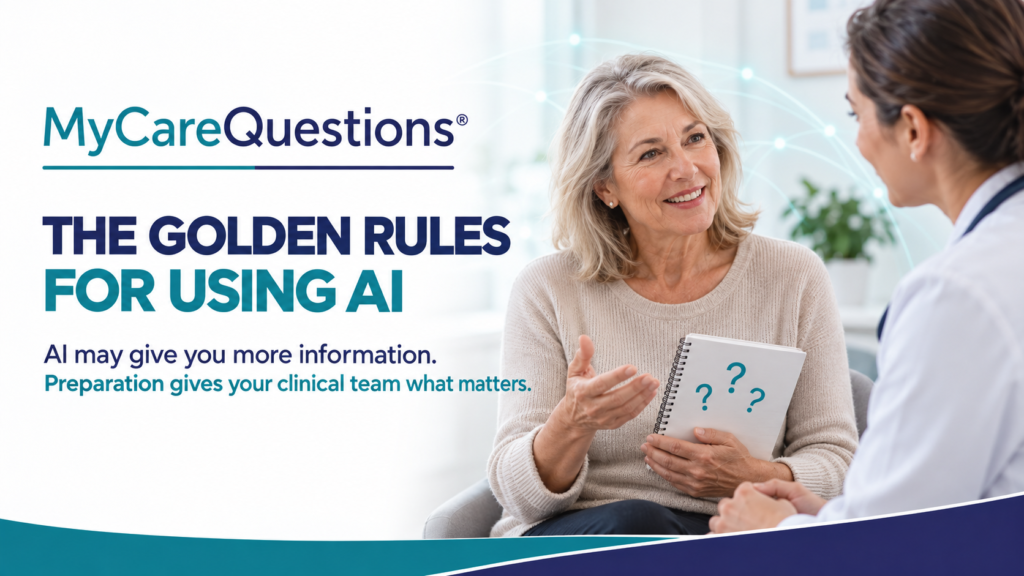
Artificial intelligence can be a powerful ally for people preparing for a medical consultation. It can explain unfamiliar terms, organise thoughts, suggest questions and help a person feel less alone. But it must be used in the right role: as a preparation tool, not a diagnosis, treatment plan or substitute for clinical judgement.
MyCareQuestions proposes a simple public standard: AI should help patients arrive SEEN, HEARD and UNDERSTOOD – with a clearer account of what matters to them and better questions for their clinical team. It must never be allowed to quietly become the clinician in the room.
Executive summary
Patients are already using generative AI before consultations. In a US peer-reviewed survey, nearly half of AI health-information users said they used it to decide whether a consultation was needed, while nearly a third reported changing medication after using it. That is not a reason to fear AI. It is a reason to give the public a safer, clinician-led way to use it.
MCQ therefore supports a controlled model: independent clinical authorship; carefully scoped patient preparation; plain-English questions; explicit safety escalation; transparent sponsorship; and a clear hand-off back to the patient and their own medical team. This is human-centred AI in practice.
The opportunity and the problem
The promise is genuine. Conversational AI can reduce jargon, summarise a patient’s own notes and make it easier to ask difficult questions. A longitudinal Danish study found that first-hand exposure to ChatGPT reduced uncertainty about AI in healthcare and tended to shift previously undecided people towards seeing benefits. Familiarity is increasing confidence.
“Exposure to ChatGPT reduced the uncertainty of perceived benefits and risks of AI applied in healthcare.”
Isaksen et al., npj Digital Medicine, 2025
The risk is equally real: a persuasive answer can be mistaken for a sound one. AI may omit crucial context, produce an inaccurate answer with confidence, or encourage action before a clinician has assessed the person. The strongest available studies are primarily surveys, simulations and quality assessments; they do not demonstrate that unguided AI research improves health outcomes. That gap matters.
What published evidence tells us:
| Published evidence | What it found | What MCQ should do with it |
| Ayo-Ajibola et al., JMIR 2024 | 21.5% of 2,406 respondents had used ChatGPT for health information. Users commonly sought help deciding whether to consult and exploring treatment options. 31.0% reported changing medication; 67.5% discussed output with a clinician. | Design AI use around better consultation preparation and an explicit “take this to your clinician” hand-off. |
| Ayo-Ajibola et al., JGIM 2025 | People with a regular source of primary care were less likely to use ChatGPT for health information (adjusted OR 0.56). | Treat AI as a response to an information and access gap, not as a replacement for continuity of care. |
| Isaksen et al., npj Digital Medicine 2025 | Among 5,899 Danish adults, AI exposure was associated with movement from uncertainty to a more positive view of AI in healthcare. | Confidence rises with exposure; safeguards and literacy must rise with it. |
| Abanmy et al., Frontiers in AI 2025 | In a medication-information assessment, some ChatGPT responses contained potentially harmful material; authors concluded it was not reliable as a standalone source. | No medication changes, doses, stopping treatments or urgent triage decisions from AI alone. |
| Nov, Singh and Mann, 2023 | In a US representative experiment, people only moderately distinguished chatbot from clinician replies and trusted low-risk uses more than complex clinical tasks. | Never present generic AI content as clinician advice. Mark the boundary clearly and visibly. |
The MCQ position
We reject two lazy positions: that patients should avoid AI altogether, and that a general-purpose chatbot is an adequate substitute for a prepared consultation. Both misunderstand where value lies. AI can improve preparation. Clinicians remain responsible for interpretation, diagnosis and treatment decisions.
“The important question is not whether patients will use AI. They will. The question is whether they will be helped to use it in a way that improves the conversation with their clinical team.”
MyCareQuestions position statement
MCQ is designed to sit in the productive middle: patients retain agency; clinicians define the clinically meaningful questions; and the final consultation remains human, personal and accountable.
The ten Golden Rules
1 Start with preparation, not diagnosis
Use AI to organise your story, symptoms, priorities and questions. Do not ask it to decide what condition you have.
2 Tell your clinician what you used
Bring the useful output with you. It gives your clinician a chance to correct, contextualise and build on it.
3 Never change medication from an AI answer
Do not start, stop, alter doses, substitute medicines or delay prescribed treatment without speaking to a qualified clinician or pharmacist.
4 Treat urgent symptoms as urgent
Do not use an AI chat as a triage service in an emergency. Use 999, NHS 111, your local urgent-care route or the advice you have been given.
5 Protect your privacy
Do not upload identifiable medical letters, scan results, NHS numbers, addresses or images unless you understand the service, its privacy terms and who can access the data.
6 Ask for sources and check them
Ask AI to identify current, credible sources. Prefer verified clinicians, ideally linked to the NHS, NICE, professional-society and recognised hospital information. Check dates.
7 Beware confident language
A fluent answer can still be incomplete or wrong. Ask: what information is missing, what could change this answer, and what should I ask my clinician?
8 Do not let AI choose between treatments
AI can help you understand options. Your medical team must apply your history, examination, tests, values and risk profile. Don’t underestimate the benefit of a clinicians experience obtained over decades.
9 Use a clinician-designed question set
A focused set of specialty-specific questions is safer and more useful than an open-ended conversation that drifts into speculation. Guardrails are the foundation of good AI use, and who controls the guardrails matters.
10 Keep the human conversation central
The success measure is not a clever AI answer. It is a better consultation: clearer priorities, shared understanding and an agreed next step. A prepared patient is wonderful for a clinician. No Clinician would mind being challenged by a prepared patient, indeed for the experienced doctors this is the ideal consultation.
The MCQ guardrail model
MCQ is not a diagnosis engine and does not provide individual medical advice. It is a clinician-led preparation service built around questions that help people articulate their circumstances, concerns and goals before meeting their own clinical team.
| Guardrail | What it means |
| Clinical authorship | Specialty clinicians determine what patients need to consider and ask. |
| Scope control | The service is designed for preparation and education, not diagnosis, prescribing or emergency decision-making. |
| Question-first design | The output is a structured My-Life Summary and suggested questions, rather than a treatment recommendation. |
| Safety and escalation | Clear routes are signposted when symptoms may need urgent clinical attention. |
| Transparency | Patients can see the role of clinicians, the limits of the service and any sponsor support. |
| Editorial independence | Sponsors may fund reach, but do not control clinical content or patient-facing questions. |
| Continuous review | Content should be checked and updated by relevant clinicians as evidence and practice evolve. |
A call to clinicians and institutions
Clinicians should not leave this field to technology companies, influencers or search algorithms. Patients need public-facing guidance from people who understand both the science and the lived reality of uncertainty before a consultation. That makes this a legitimate and important area for clinical leadership, media commentary and institutional education.
MCQ invites clinician panels to also contribute to our published specialty agnostic Golden Rules, contribute media commentary and help set a higher public standard for AI-enabled patient preparation. This is not promotion of a technology. It is responsible stewardship of a behaviour that is already widespread.
Recommended media statement
“AI can be helpful when it helps a patient prepare better questions and communicate what matters to them. It becomes unsafe when it is treated as a diagnosis, a prescription or a replacement for the clinician who knows the person in front of them. Our role is to give people clear guardrails so technology strengthens, rather than weakens, the clinical conversation.”
Conclusion
AI will become part of how people research health. The choice is not between uncontrolled use and no use. The better choice is clinician-guided use: transparent, limited to the right task, respectful of privacy, and always designed to improve the quality of the human consultation. That is the space MCQ should lead.
References
Ayo-Ajibola O, Davis RJ, Lin ME, Riddell J, Kravitz RL. Characterizing the Adoption and Experiences of Users of Artificial Intelligence-Generated Health Information in the United States: Cross-Sectional Questionnaire Study. Journal of Medical Internet Research. 2024;26:e55138. doi:10.2196/55138.
Ayo-Ajibola O, et al. Association of Primary Care Access with Health-Related ChatGPT Use: A National Cross-Sectional Survey. Journal of General Internal Medicine. 2025. doi:10.1007/s11606-025-09406-9.
Isaksen AA, et al. Changes in public perception of artificial intelligence in healthcare after exposure to ChatGPT. npj Digital Medicine. 2025. doi:10.1038/s41746-025-02169-x.
Abanmy NO, et al. Evaluating the accuracy of ChatGPT in delivering patient instructions for medications: an exploratory case study. Frontiers in Artificial Intelligence. 2025. doi:10.3389/frai.2025.1550591.
Nov O, Singh N, Mann D. Putting ChatGPT’s Medical Advice to the Turing Test. 2023. Preprint. doi:10.48550/arXiv.2301.10035.
World Health Organization. Ethics and governance of artificial intelligence for health: guidance on large multi-modal models. WHO; 2024.