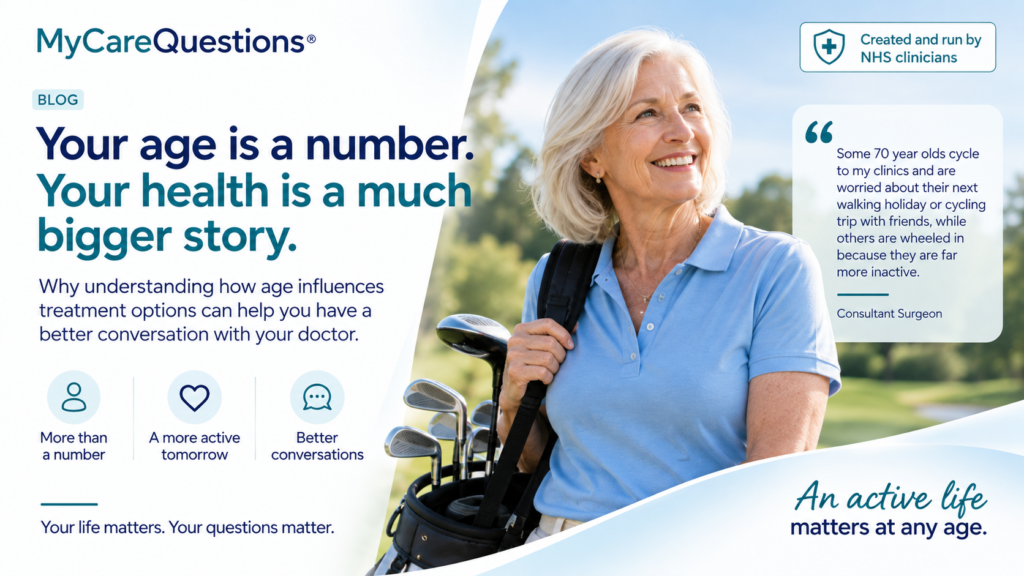
Why medicine needs age cut-offs—and why patients should never be reduced to one
Imagine two patients arriving at the same hospital.
Both are 75.
One walks several miles every day, plays golf twice a week and is planning a walking holiday. The other needs help dressing, rarely leaves home and has several serious health conditions.
On paper, they share the same age. Medically, they may have almost nothing else in common.
Yet turning 75 can alter the treatment a patient is offered. It can influence whether someone is steered towards open-heart surgery or a less-invasive procedure. Similar age boundaries appear in fertility treatment, cancer screening, blood-pressure management, vaccinations and some cancer-treatment pathways.
Why does medicine use these cut-offs? Are they clinically justified—or are they simply a convenient way of controlling costs?
The honest answer is: sometimes they are useful, sometimes they are necessary, and sometimes they are far too crude.
The problem with the “average patient”
Medical research depends on averages.
A clinical trial may compare two treatments in several thousand people. Researchers calculate which treatment worked best, how often complications occurred and whether the improvement was large enough to justify the risks and costs.
This is essential. Without trials, medicine would be based largely on professional opinion, habit and hope.
But the result describes what happened to a group. It cannot predict with certainty what will happen to you.
The “average patient” created by a study is a statistical construction. They have the average age, average level of illness and average response to treatment. In the real world, that patient does not exist.
You may be fitter than most people your age. You may have unusually strong family support, excellent kidney function or a powerful reason for wanting to remain active. Equally, a younger patient may have significant frailty, poor mobility or other illnesses that make an intensive treatment less appropriate.
Averages help doctors understand populations. They should not be allowed to erase the person sitting in front of them.
Why age cut-offs exist
Age is used because it often tells clinicians something useful.
As people grow older, the likelihood of frailty, complications and slower recovery generally increases. Some treatments take years to deliver their full benefit. Others may become less effective with age, while the risks may increase.
Age is also simple. It is recorded for every patient, easily measured and understood by every hospital. Frailty, resilience, independence and personal priorities are more difficult to capture.
There is another uncomfortable reality: healthcare resources are finite.
The NHS cannot provide every possible intervention to every person who might receive a small benefit from it. Guideline committees must consider clinical benefit, harm, affordability, staffing, hospital capacity and the opportunity cost of spending money in one place rather than another.
Age cut-offs are therefore a necessary evil—or, perhaps more fairly, a necessary imperfection. They allow a national healthcare system to turn complex research into recommendations that can be applied consistently.
The danger begins when a useful guide becomes an inflexible gate.
The heart-valve example
Severe aortic stenosis is a narrowing of the valve through which blood leaves the heart. Once significant symptoms develop, replacing the valve may be the only effective treatment.
There are two principal approaches:
- Surgical aortic valve replacement, or SAVR, involves open-heart surgery.
- Transcatheter aortic valve implantation, or TAVI, normally delivers the new valve through an artery, often from the groin.
NICE guidance has used 75 as an important dividing point: surgery has generally been favoured for lower-risk patients under 75, while TAVI has been favoured for patients aged 75 or over or at higher surgical risk. More recent European guidance has moved its principal TAVI age point from 75 to 70.
But nothing magical happens to the human body at midnight before a 75th birthday.
A highly active 76-year-old may have a better recovery potential than a sedentary 68-year-old. The younger patient may have anatomy that makes TAVI preferable. The older patient may value valve durability differently or have a strong preference for one approach.
Age provides a starting point. Anatomy, frailty, surgical risk, life expectancy, lifestyle, valve durability and patient preference should complete the picture.
Most importantly, the age boundary concerns the choice between treatments. It should not become a reason to leave severe, symptomatic valve disease untreated.
“Guidelines are like sausages”
One leading NHS cardiac surgeon described the problem memorably:
“Medical guidelines are like sausages: if you knew how they were made, you wouldn’t eat them.”
Consultant cardiologist Dr Paddy Barrett has made a similar observation publicly:
“Medical guidelines are like sausages. Everyone loves them. But no one wants to know what goes into them.”
This should not be interpreted as meaning that guidelines are worthless or deliberately misleading. It means that the clean, confident recommendation seen by patients is often the final product of a much messier process.
Behind a single sentence may sit:
- Clinical trials that studied slightly different types of patient.
- Older people, women or people with multiple illnesses who were underrepresented in the evidence.
- Results showing only small differences between treatments.
- Disagreement about which outcomes matter most.
- Uncertainty about benefits that may take ten or twenty years to appear.
- Economic modelling based on assumptions about costs and quality of life.
- Debate between surgeons, physicians, commissioners, methodologists and patient representatives.
- A final compromise that the committee can collectively support.
This is not necessarily “guessing”. It is structured judgement in the presence of incomplete evidence.
Modern organisations such as NICE attempt to make this process more trustworthy. Committees include clinicians, researchers, commissioners and lay members. Financial and professional interests must be declared and managed. Evidence quality is assessed systematically, costs and savings are considered, and draft recommendations are opened to consultation. NICE also has a legal responsibility to consider equality and the effect of its recommendations on protected groups, including older people.
The sausage metaphor remains valuable because it reminds us that a guideline is made by humans. It is not a law of nature.
When age becomes dangerous
Age becomes dangerous when it quietly replaces a proper assessment.
A patient may hear:
- “We don’t normally operate on people over 80.”
- “At your age, the gentler option would be better.”
- “You probably wouldn’t cope with chemotherapy.”
- “There would be little point putting you through rehabilitation.”
- “Conservative treatment would be kinder.”
Any of these conclusions might eventually prove correct. But none is sufficient without explaining how the decision was reached.
Was frailty formally assessed? Was the patient’s usual activity considered? Were their kidney, lung and heart functions measured? Did the team ask what they wanted to return to doing? Was the case discussed by the relevant multidisciplinary team? Were all reasonable options explained?
The financial pressure is real, but it is rarely as simple as a hospital deliberately denying treatment to save money. The greater danger is subtler: when services are under pressure, age can become an administratively convenient substitute for individual assessment.
That can save time and reduce activity. It can also produce profoundly unfair decisions.
Guidelines can protect older patients too
Age-based guidance is not always restrictive.
In atrial fibrillation, increasing age raises the calculated risk of stroke and can strengthen the case for anticoagulation. Older people are prioritised for osteoporosis assessment and several vaccinations. NICE explicitly states that people should not be excluded from referral for joint replacement simply because of their age.
Screening programmes also demonstrate an important distinction between an automatic invitation and an absolute prohibition. Routine bowel screening invitations end at 74, but people aged 75 and over can request a test. Automatic breast-screening invitations stop after 70, but women aged 71 and over can continue to request screening every three years.
However, requiring someone to know about a service and ask for it creates a new barrier. A test that is technically available but no longer routinely offered will inevitably reach fewer people.
The better alternative: measure what actually matters
Replacing every age boundary is not realistic. National systems require rules, and some age thresholds reflect genuine differences in benefit and risk.
But chronological age should increasingly be supplemented by more meaningful measures:
- Frailty and mobility.
- Independence and cognition.
- Heart, lung and kidney function.
- Existing illnesses and medications.
- Biological features of the disease.
- Likely years of healthy life—not simply years already lived.
- The patient’s goals, values and willingness to accept risk.
- The strength of family and community support.
- The activities the person wants treatment to preserve.
A person worried about losing the ability to walk the dog, play golf, work, travel or care for a partner is telling the clinical team something important. These are not lifestyle details sitting outside the medical decision. They help define what successful treatment would mean.
Questions worth asking
If age appears to be influencing your care, reasonable questions include:
- Is this a national guideline, a local funding policy or your clinical recommendation?
- Is my age being used as guidance or as an absolute cut-off?
- How have you assessed my individual fitness and frailty?
- Would the recommendation be different for a younger patient with the same health and functional ability?
- What are the likely benefits and risks for me personally?
- What other treatment options are available?
- Has my case been discussed by the appropriate multidisciplinary team?
- Could another specialist or hospital offer a different option?
- What could I do to improve my ability to undergo treatment?
- Can the reasons for the decision be recorded in my notes?
These questions do not challenge the expertise of the clinical team. They help the team apply that expertise to the person rather than merely to the category.
Age may inform the decision. It should not make the decision.
Medical guidelines are essential. They reduce unjustified variation, improve safety and help ensure that NHS resources produce as much benefit as possible.
But guidelines describe groups. Doctors treat individuals.
Your age is relevant, but it is not a complete account of your health. It does not show how far you can walk, what you hope to keep doing, how strongly you might recover or what degree of risk you are prepared to accept.
The answer is not to throw away guidelines. It is to understand their limitations and ensure that they open a conversation rather than close one.
Because your birthday is a fact.
It is not a diagnosis.