Rory Sutherland, Vice Chairman of Ogilvy, has spent much of his career explaining a strange but powerful idea: the way we look at something can change the value of the thing itself. Ogilvy describes his work as finding “small contextual changes” that can have enormous effects on the decisions people make.
In his TED talk, Sutherland argued that advertising can add value by changing perception, not the product itself. A train journey, a restaurant meal, a bottle of wine, even waiting for a taxi — the physical facts may not change much, but the experience can change dramatically when the meaning changes.
Healthcare is not a restaurant. It is far more serious. But the principle still matters.
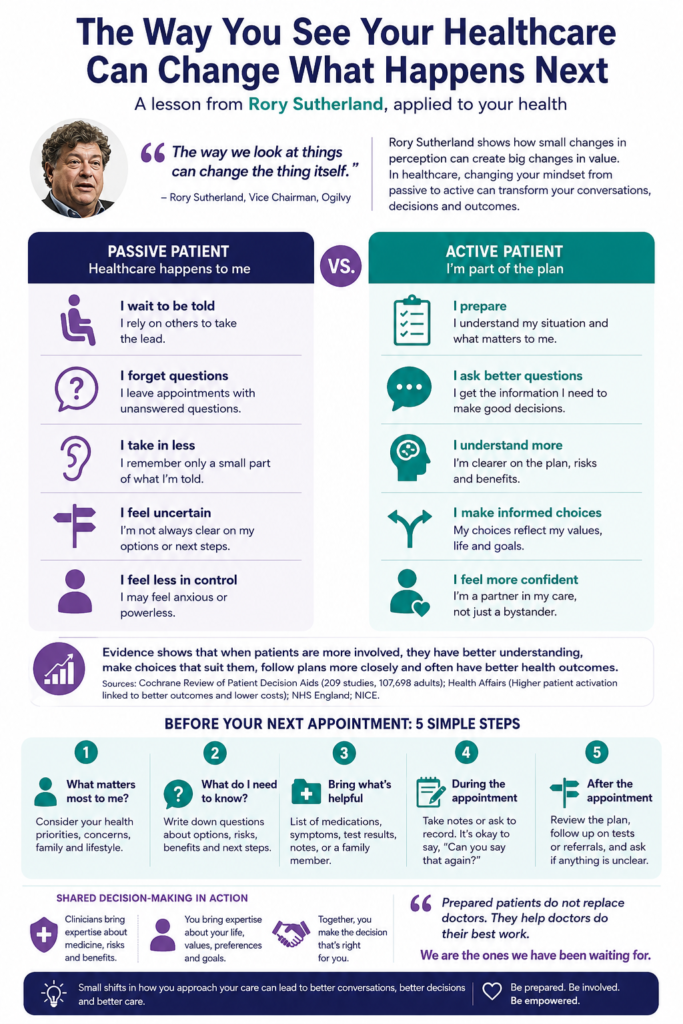
When you are told you have a heart problem, need surgery, or must see a specialist, it is natural to feel passive. You may feel that the system is happening to you. Letters arrive. Appointments are booked. Medical words appear. Doctors talk. You listen. You nod. You go home and realise you did not ask half the questions you wanted to ask.
But the moment you prepare, the frame changes.
You are no longer “just a patient waiting to be told”. You become a person arriving with your story, your priorities, your fears, your family context and your questions. That does not mean you become the doctor. It means you help the doctor understand the person behind the scan, the blood test or the diagnosis.
That distinction is vital.
NHS England describes shared decision-making as a process where the clinician brings expertise about options, risks and benefits, while the patient brings expertise about their preferences, values, beliefs and personal circumstances. NICE makes a similar point: good care should be based not only on clinical evidence, but also on the person’s individual preferences, beliefs and values.
This is where Rory Sutherland’s thinking becomes useful. The clinical facts may be the same, but the patient’s role has changed. The appointment is no longer something to endure. It becomes something to prepare for.
That small shift can matter.
A large Cochrane review of patient decision aids found that these tools help adults become more involved in health decisions by improving knowledge, expectations of benefits and harms, and clarity about what matters most to them. The review included 209 studies and 107,698 adults.
Patient activation research points in the same direction. A Health Affairs study found that higher patient activation was associated with better outcomes in nine out of thirteen measures, including healthier behaviours and lower costs two years later. The authors were careful not to overclaim causation, but the association is important.
The behavioural economists Daniel Kahneman and Amos Tversky showed that the way a decision is framed can predictably change people’s choices, even when the underlying facts are the same. In healthcare, this means the way patients understand their situation — “I am helpless” versus “I can prepare” — can alter what they ask, what they remember, and how confidently they take part.
This is not about being difficult. It is not about challenging doctors for the sake of it. It is about helping the consultation work better.
Before your next appointment, try asking yourself:
What do I need this doctor to understand about my life?
What am I most worried about?
What treatment options might exist, and why might one suit me better than another?
What happens if we wait, monitor, treat, refer or operate?
What would make this consultation feel successful for me?
NHS England says patients should be encouraged to consider what matters to them, what they hope will happen, and what questions they would like to ask before a consultation. Aqua’s “Ask 3 Questions” approach also encourages patients to ask what their options are, what the benefits and risks are, and how they can get support to make the right decision.
That is the quiet power of preparation.
Rory Sutherland often reminds us that not all value is mechanical. Some value is psychological. A restaurant can improve the meal by changing the setting. A railway can improve the journey by changing the experience of waiting. A healthcare consultation can improve when the patient arrives prepared, calm and ready to explain what matters.
The diagnosis may not change.
But the conversation can.
And sometimes, the conversation is where better care begins.